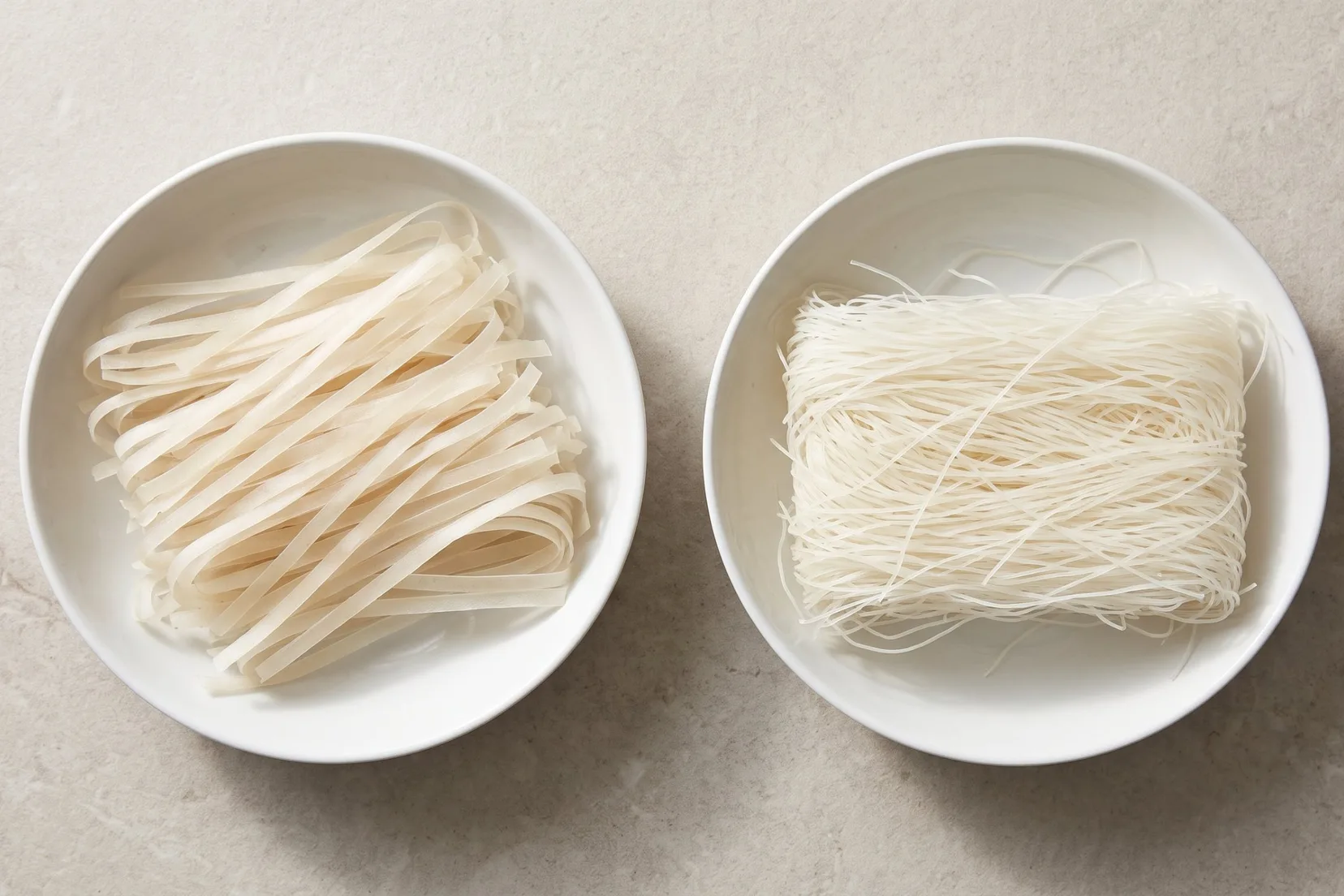
Rice vermicelli is a rice noodle cut to about 1 mm. That is the difference most guides stop at. For a buyer, the bigger one is on the back of the bag: the vermicelli we publish lists corn starch first.
A width you can see on the shelf. A starch system you only see on the specification. Both change the dish, the panel and the label you print.
The Name Says Rice. The Statement May Not.
Our published pad thai stick reads rice 84 percent and water 16 percent. Two ingredients, and rice is most of the noodle. Not every rice noodle is that simple: the fresh pho line adds a barley-derived enzyme, more on that below.
Our documented rice vermicelli reads corn starch 52 percent, rice flour 36 percent and water 12 percent. It is sold as rice vermicelli, and it is more corn than rice.
That is common in thin noodles. Starch gives a 1 mm strand the strength to survive drying, packing and cooking without breaking into short pieces. It also means the ingredient line on your pack starts with corn starch, because US labels list ingredients in descending order of predominance by weight.
If your customer expects a rice-first statement, say so in the brief. A rice-only vermicelli and a starch-blend vermicelli are two different specifications, even when the name on the front is the same.
Width Is the Part Everyone Sees
| Attribute | Rice noodles and rice sticks (figures: published pad thai stick) | Rice vermicelli |
|---|---|---|
| Ingredients | Pad thai stick: rice 84%, water 16%. Fresh pho adds a barley-derived enzyme | Corn starch 52%, rice flour 36%, water 12% |
| Width | Pad thai 1 by 5 mm; Singapore style 1.5 to 2 mm; Hong Kong style 2.7 to 3.2 mm; fresh pho 8 to 8.5 mm | 1 mm |
| Formats | Dry, plus fresh pho | Dry, in a 210 by 140 by 20 mm cake |
| Shelf life | 24 months dry; 12 months fresh pho | 24 months |
| Moisture | 13.1% | 13.1% |
| Origin | China | China |
Rice noodles are a family of cuts. Rice vermicelli is one cut, the thinnest, and on our line it arrives as a pressed rectangular cake of strands about 200 mm long.
The cake matters more than it looks. It sets how many portions fit a case, how the noodle breaks in transit and how a kitchen portions it. A cake that suits a retail bag may not suit a production line that weighs noodles by the gram.
What the Panel Shows
Same moisture, very different panels. Per 100 g, dry, our published pad thai stick against our rice vermicelli:
- Protein. Pad thai stick 7 g. Rice vermicelli 0.24 g. Corn starch carries almost no protein, so the starch-heavy noodle reads close to zero.
- Carbohydrate. Pad thai stick 78 g. Rice vermicelli 88.6 g.
- Fat. Pad thai stick 1.8 g. Rice vermicelli 0.15 g.
- Sodium. Pad thai stick 0.4 mg. Rice vermicelli 69 mg.
- Energy. 355 kcal against 352 kcal. Close enough that calories will not separate them.
If your product carries a protein figure on the front, start from the rice noodle line. We can raise protein with pea protein on applicable rice noodle lines. On a 1 mm starch-blend vermicelli, protein is not a lever we publish.
Which Dish Takes Which Noodle
Choose by what the noodle has to do in the dish, not by the name on the menu.
Stir-fried and sauced. Pad thai, pad see ew and similar dishes need a flat noodle that carries sauce and holds up in the pan. That is a rice stick, 1 by 5 mm for pad thai, flat or round for pad see ew.
In a broth. Pho takes the wide 8 to 8.5 mm fresh noodle. For thinner broth bowls, Singapore and Hong Kong style cuts sit between the two.
Fine and light. Rice vermicelli goes where a delicate strand matters: soup and noodle bowls with a fine cut, rice paper rolls and spring rolls, and prepared meals that want a light noodle among other components.
Retail packs. Both work as standalone dry packs and inside meal kits with a separately packed sauce. Pick the width the recipe on the pack calls for.
When one menu slot could take either, cook both in your own process before you decide. A 1 mm strand and a 5 mm stick behave differently in a hot hold and in a delivery box.
Gluten: What You Can Claim
Rice and corn do not contain gluten, but that does not settle it for every line. Our fresh pho lists a barley-derived enzyme (beta-amylase) in its ingredient statement, and barley is a gluten grain. Choose the line by its ingredient statement, not by the word rice on the bag. A gluten-free claim on your pack is a separate question again.
In the US, a gluten-free claim means the food contains less than 20 ppm gluten. That depends on the plant, the shared lines and the testing, not only on the recipe. Our allergen statements for both lines are available on request. Ask for them, and for test results, before you print the claim.
Writing the Brief
A rice noodle brief and a vermicelli brief ask the same questions with different answers. Tell us:
- Width and cut. 1 mm vermicelli, or the stick, flat or round width your dish needs. A sample of the noodle you use now settles it fastest.
- Starch system. Rice only, or rice with added starch. If the first ingredient on your label matters, put it in writing.
- Format. Dry, or fresh for pho, and the cake or nest shape your line handles.
- Panel targets. Protein, sodium or any figure your front of pack depends on.
- Claims. Gluten-free or any other claim you plan to print, so testing is part of the program.
- Pack and volume. Retail bag, foodservice case or kit portion, and how much, how often.
Every lot ships against the specification you sign, and you get samples before you commit. For every width we supply, start with rice noodles and rice sticks and rice vermicelli. For the other noodle families, see our noodles, or read the ramen noodles guide for wheat.
Frequently Asked Questions
Is rice vermicelli the same as rice noodles?
It is one kind of rice noodle: the thinnest cut, about 1 mm. Rice noodles also include flat sticks for pad thai and wide pho noodles. On our lines the formulations differ too: the published pad thai stick is rice and water, the vermicelli is mostly corn starch with rice flour.
Why does rice vermicelli contain corn starch?
Starch helps a very thin strand hold together through drying, packing and cooking. Our documented vermicelli is corn starch 52 percent, rice flour 36 percent and water 12 percent. If you need a rice-first ingredient statement, ask for it in the brief.
Can I use rice vermicelli instead of rice sticks?
For a broth bowl or a roll, often yes. For pad thai or any dish fried in sauce, a 1 mm strand is too fine and breaks. Match the width to how the dish is cooked.
Which one has more protein?
Rice noodles, by a wide margin: 7 g per 100 g for our published pad thai stick against 0.24 g for our vermicelli. The rice noodle line can also be raised with pea protein.